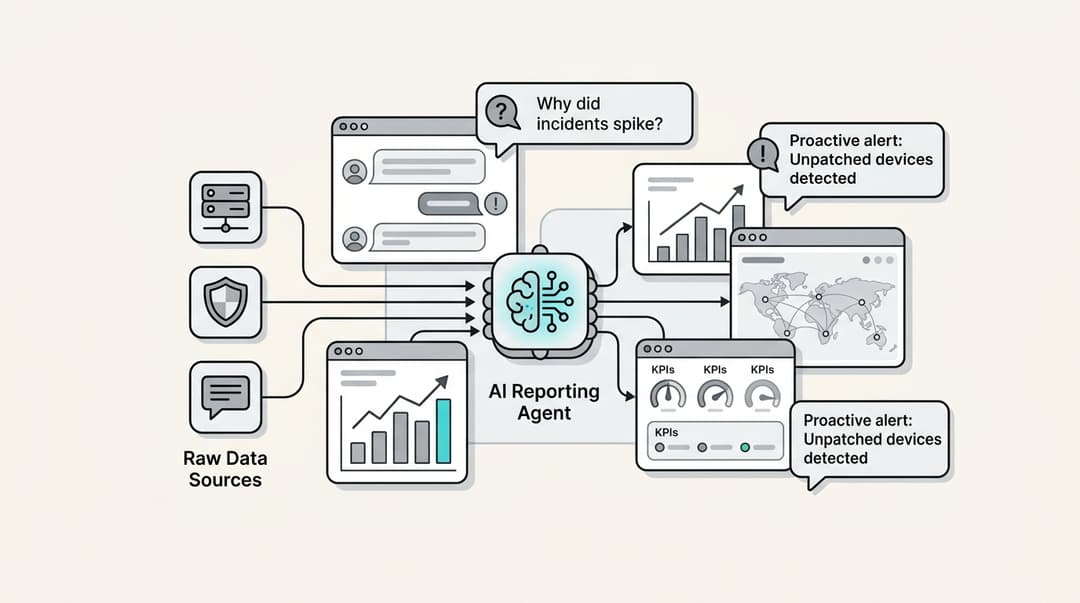
Chatbase vs Tidio: Complete 2026 Comparison

Stevia Putri
Last edited April 30, 2026

If you need a fast AI chatbot trained on your documents for FAQ automation, Chatbase wins on setup speed, taking under 10 minutes to live. If you require live chat alongside AI with a unified inbox for social channels, Tidio is the better fit. Full comparison below.
Choosing between Chatbase and Tidio often comes down to one question: are you hiring a librarian or a support team? In 2026, the AI chatbot market has split into these two distinct camps. One focuses on making your internal knowledge conversational, while the other builds a suite to manage your entire customer relationship.
The stakes are higher than ever. With customers expecting instant, accurate answers across every channel, picking the wrong architecture can lead to frustrated users or a "hallucinating" bot that damages your brand trust. This guide breaks down the core differences in how these two leaders handle data, workflows, and pricing to help you make the right choice for your operation.
What are Chatbase and Tidio?
Chatbase is a specialized AI chatbot builder designed for speed and simplicity. It functions primarily as an "AI Librarian" for your business knowledge. You feed it PDFs, text files, or website URLs, and it uses Large Language Models to answer questions based strictly on that data. It is widely used for SaaS products, internal HR wikis, and developer documentation where the goal is to deflect simple questions without complex setup.
Tidio, on the other hand, is a full-stack customer support platform. It combines live chat, a centralized help desk, and an AI agent named Lyro. While Chatbase is often a passive tool that waits for questions, Tidio is built for the entire support lifecycle. It includes visual "Flows" to proactively greet visitors and an omnichannel inbox that unifies messages from email, WhatsApp, and Instagram.
If you find that both of these options feel like too much "tool" and not enough "team," you might want to look at eesel AI. We built eesel AI to be a true autonomous teammate that joins your workspace and starts working in minutes. Instead of configuring a bot, you hire an agent that handles your frontline support end-to-end.
Data training and accuracy: How they learn from your business
The quality of an AI agent is only as good as the data it consumes. Chatbase and Tidio take very different paths to "learning" your business.
How Chatbase manages knowledge
Chatbase is built for deep document training. It allows you to upload massive amounts of content, including Notion pages, Google Drive folders, and hundreds of PDFs. Once uploaded, the AI indexes this information so it can provide citations for its answers. This makes it exceptionally accurate for technical queries where a specific manual or policy must be referenced.
How Tidio Lyro AI works
Tidio takes a systematic approach with its Lyro AI agent. Lyro is designed to scrape your website and ingest your existing FAQ content. A key difference is the "human-in-the-loop" element: Tidio encourages agents to review AI responses and "promote" successful ones to verified knowledge. This is helpful for e-commerce brands where product details change frequently and need constant validation.
Accuracy and hallucination risks
Both platforms use advanced models, including Claude from Anthropic, to power their responses. However, because Chatbase is more of a "document reader," it tends to stay closer to the text provided. Tidio’s Lyro is optimized for conversation, which makes it sound more human but requires more careful monitoring of its FAQ base to ensure it does not deviate from your brand voice.
Support workflows and human handoff: Managing the inbox
A chatbot that cannot pass the baton to a human is a liability. This is the area where the two platforms diverge most significantly.
Tidio was built as a live chat tool first and an AI tool second. This legacy is clear in its omnichannel inbox, which allows human agents to see a real-time preview of what a customer is typing before they even hit send. If the AI gets stuck, a human can jump in instantly. It also supports ticketing automations that organize requests by customer intent, ensuring your team focuses on the most urgent issues.
Chatbase has a significant limitation here: it does not have a native live chat inbox for your team to manage. It is designed to be an autonomous layer on your site or an API integration. To get human handoff, you typically have to connect it to another tool like Zendesk or Slack using their API. For teams that want a "set it and forget it" FAQ bot, this is fine, but for those managing high-stakes support, the lack of a native human workspace is a hurdle.
Pricing comparison: Billable conversations vs. message credits
The "total cost of ownership" for these tools can be confusing because they use different billing units. Chatbase bills based on "Message Credits," while Tidio uses "Billable Conversations."
| Feature | Chatbase | Tidio |
|---|---|---|
| Starting Price | $32/mo (Standard $120/mo) | $24.17/mo (Starter) |
| Pricing Unit | Per Message Credit | Per Billable Conversation |
| Free Tier | 50 credits/mo | 50 billable conversations |
Chatbase's pricing is generally more predictable for high-volume sites with simple questions. However, the costs scale quickly if you want to remove the "Powered by Chatbase" branding, which requires a steep annual fee.
Tidio's pricing model is more complex. You pay for seats for your human agents and then add on AI capacity for Lyro. A "Billable Conversation" only counts when a human agent replies, while Lyro has its own separate quota. This can be more cost-effective if your AI successfully resolves most tickets without human intervention.
A more autonomous teammate for helpdesk support: eesel AI
If you are looking for a solution that combines the deep learning capabilities of Chatbase with the support power of Tidio, eesel AI is the modern alternative. We don't think of our product as a "bot" you have to build. Instead, we provide an AI teammate that you hire.
Unlike the "Librarian" approach that requires you to manually upload files, eesel AI connects to your existing help center, past tickets, and internal docs instantly. It learns how your team actually talks to customers, not just what is written in your manuals.
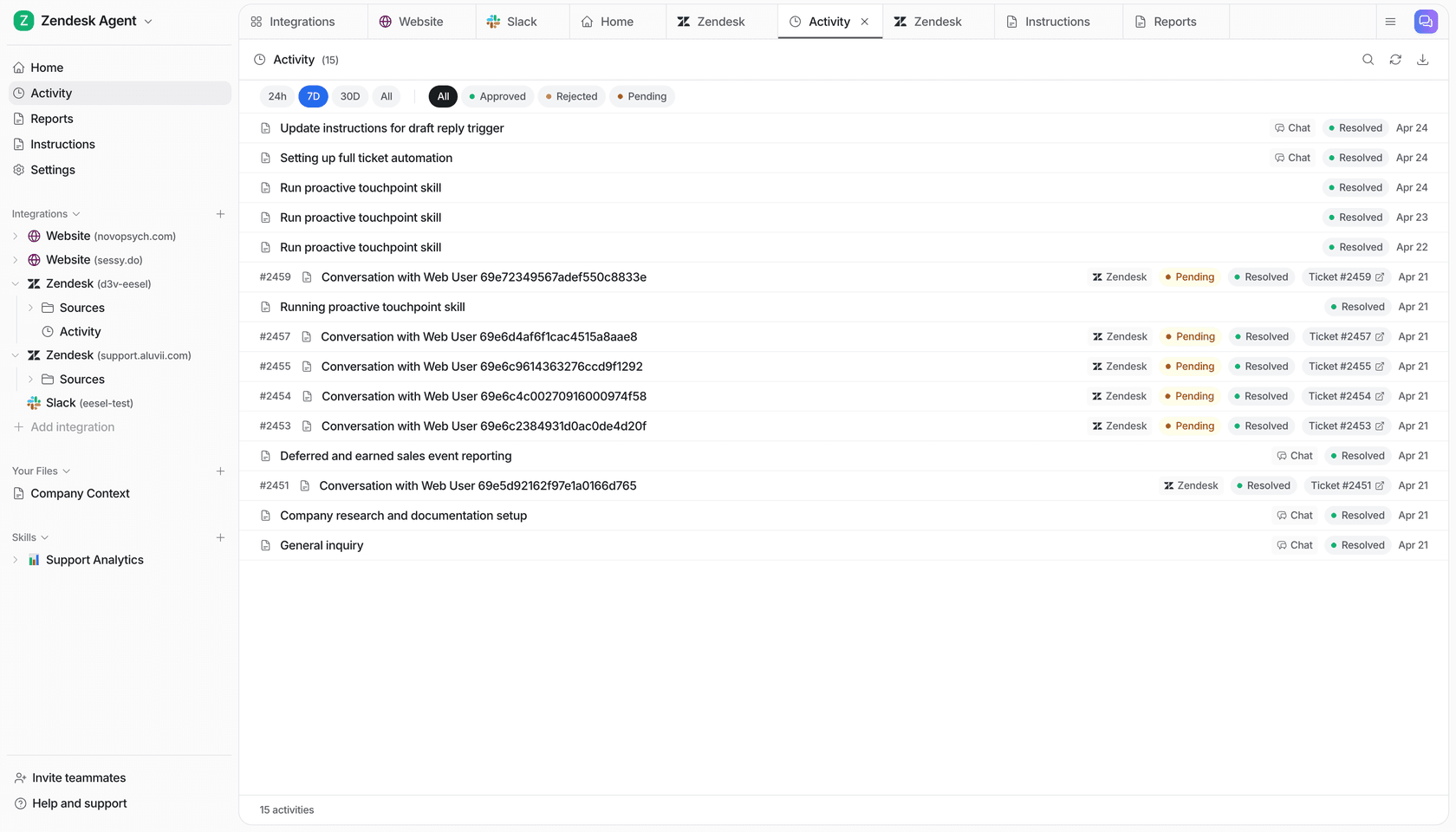
- Instant setup: No configuration screens or complex "Flow" builders. You invite eesel AI to your workspace and it gets to work.
- True autonomy: eesel AI is built to handle the frontline, drafting and sending replies so your team can focus on the edge cases.
- Fair, transparent pricing: We believe you should only pay for value. We charge $0.40 per ticket or chat session and $4.00 per blog post. There are no monthly platform fees or hidden minimums.
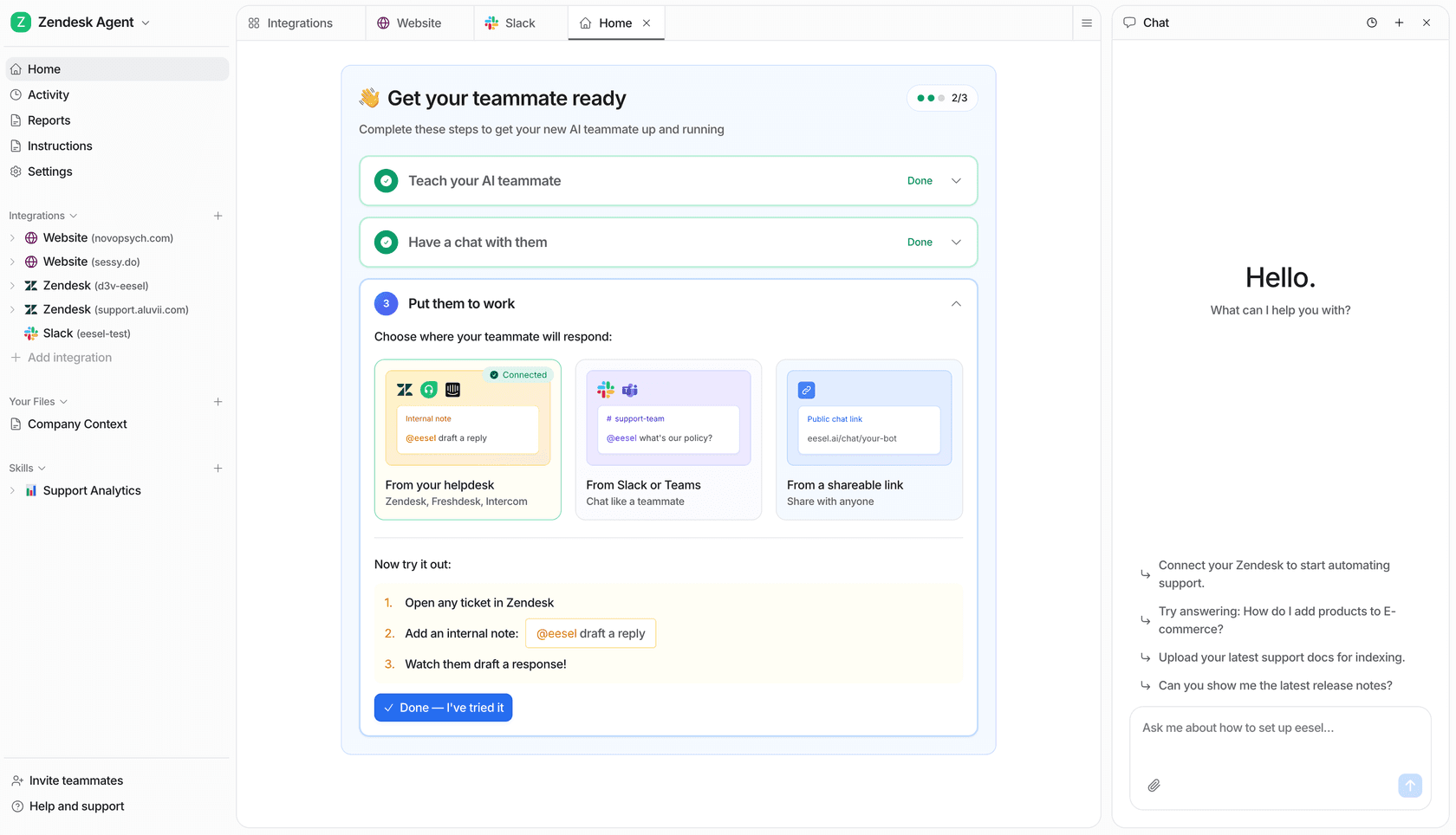
You can get started with a $50 free trial to see how an autonomous teammate changes your support workflow. Whether you use Zendesk, Slack, or any other major helpdesk, eesel AI fits right in.
Final verdict: Choosing the right AI agent for your business in 2026
Both platforms are excellent, but they serve different masters.
Choose Chatbase if:
- You need a simple FAQ bot for your website or internal knowledge base.
- You have massive amounts of documentation (PDFs, Notion) that need to be made conversational.
- You are a developer looking for a flexible API-first AI layer.
Choose Tidio if:
- You run an e-commerce store and need deep Shopify integration.
- You want a unified inbox to manage social media and website chat in one place.
- You need a visual builder to create proactive sales funnels and greetings.
Hire eesel AI if:
- You want a teammate that manages your support operation end-to-end.
- You are tired of "building" bots and want an agent that learns from your team's history.
- You prefer transparent, usage-based pricing with no platform overhead.
Bottom line? Chatbase is your librarian, Tidio is your support desk suite, and eesel AI is your newest high-performing teammate.

Frequently Asked Questions
Share this article

Article by
Stevia Putri
Stevia Putri is a marketing generalist at eesel AI, where she helps turn powerful AI tools into stories that resonate. She’s driven by curiosity, clarity, and the human side of technology.