Re:amaze vs Freshdesk: Which helpdesk is right for your business in 2026?

Stevia Putri

Stanley Nicholas
Last edited March 12, 2026
Expert Verified

Choosing between helpdesk platforms feels like comparing apples to oranges. Both Re:amaze and Freshdesk promise to streamline your customer support, but they approach the problem from completely different angles. One was built for ecommerce from day one. The other aims to serve every industry under the sun.
Let's break down what actually matters when comparing these two platforms so you can make the right call for your team.
What is Re:amaze?
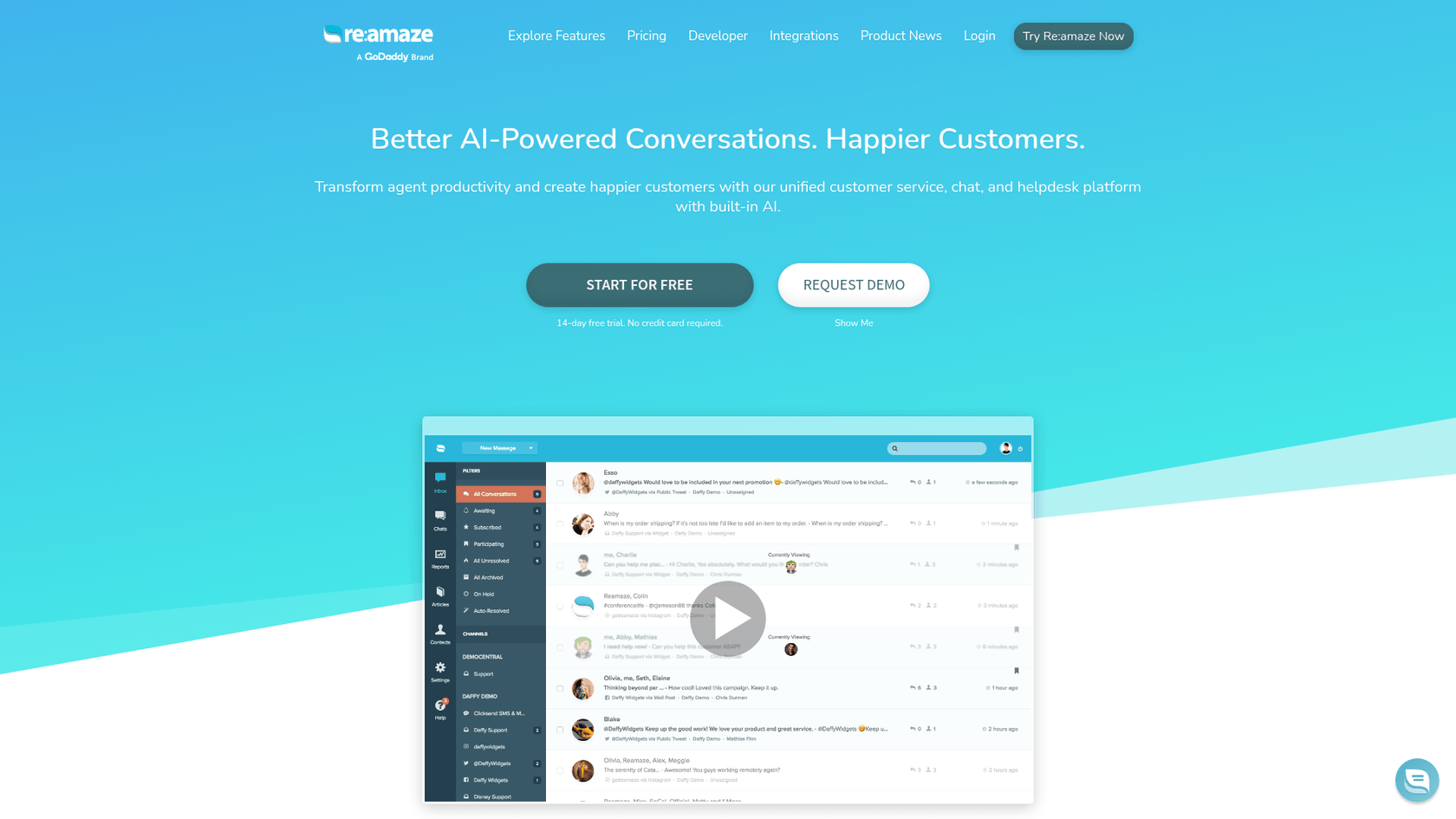
Re:amaze is a customer service platform built specifically for ecommerce and online businesses. Founded in 2012 and now part of GoDaddy, it focuses on unifying support channels into a single dashboard while maintaining deep connections to the tools online stores use every day.
The platform combines email, live chat, social media, SMS, and push notifications in one shared inbox. But where it really stands out is its native integration with ecommerce platforms. You can view customer orders, process refunds, and even create draft orders directly from a support conversation without switching tabs.
Re:amaze serves companies like Printful, BuiltBar, and Caraway, positioning itself as the helpdesk that understands the unique challenges of selling online.
What is Freshdesk?
Freshdesk comes from Freshworks Inc., a company founded in 2010 that now serves over 74,000 businesses worldwide. Unlike Re:amaze's ecommerce focus, Freshdesk casts a much wider net, targeting everything from small startups to enterprise giants like Bridgestone, Klarna, and Pearson.
Freshdesk is part of a broader ecosystem that includes CRM, IT service management, and sales tools. This means it can grow with you as your needs expand beyond basic ticketing. The platform emphasizes AI-powered automation through its Freddy AI suite, which handles everything from resolving routine queries to coaching agents in real time.
If Re:amaze is a specialized tool, Freshdesk is the Swiss Army knife of helpdesks.
Re:amaze vs Freshdesk: Feature comparison
Multi-channel support
Both platforms handle the basics well. Email, chat, social media, and SMS all flow into a unified inbox where your team can respond without juggling multiple apps.
Re:amaze includes live chat natively in all plans. You get automated messaging, chatbots, and even video calls without paying extra or installing a separate product. The social media integration goes deeper than most, pulling in Facebook and Instagram ad comments alongside regular messages.
Freshdesk approaches channels through its broader ecosystem. Live chat comes via Freshchat, which integrates seamlessly but is technically a separate product. The trade-off is broader channel coverage and more sophisticated routing options.
Ecommerce integrations
This is where Re:amaze pulls ahead significantly for online retailers. The Shopify integration is native and deep. You see customer orders, items purchased, fulfillment status, and refund history directly in the conversation view. You can process refunds, cancel orders, and create draft orders without leaving Re:amaze.
The platform also offers native integrations for WooCommerce, BigCommerce, and Magento. Dynamic variables let you pull order data into automated response templates, so customers get personalized replies that reference their actual purchases.
Freshdesk handles ecommerce through third-party integrations. You can connect Shopify stores, but the experience is more limited. Order data visibility depends on the integration quality, and actions like processing refunds typically require switching to Shopify itself.
Automation and AI
Freshdesk wins on AI maturity. Its Freddy AI suite includes three components: Freddy AI Agent for autonomous query resolution, Freddy AI Copilot for agent assistance, and Freddy AI Insights for analytics. The company claims up to 80% resolution rates for routine queries handled by AI agents.
Freddy AI Copilot summarizes long conversations, suggests responses, translates messages in real time, and even improves agent grammar and tone. For leaders, Freddy AI Insights spots trends and generates reports on demand.
Re:amaze offers an AI Agent in Beta that handles 24/7 automated support. The AI can suggest relevant FAQs, assist with drafting articles, and analyze conversation sentiment. While promising, it's newer and less proven than Freddy's established capabilities.
Reporting and analytics
Freshdesk provides more sophisticated analytics out of the box. You get pre-built reports covering response times, CSAT scores, SLA compliance, and agent performance. Custom real-time dashboards let different teams track the metrics that matter to them.
The custom object analysis feature is particularly powerful for businesses with unique data needs. You can create custom objects (like tracking specific project types) and analyze support trends related to them.
Re:amaze offers solid reporting on conversation volume, response times, and staff performance, but the advanced features are limited to higher-tier plans. For most small to mid-sized ecommerce operations, the available metrics are sufficient. Larger teams needing deep analytics will find Freshdesk more comprehensive.
Re:amaze vs Freshdesk: Pricing comparison
Pricing structures reveal a lot about who each platform targets.
| Plan | Re:amaze | Freshdesk |
|---|---|---|
| Free/Starter | $59/month flat (500 conversations, unlimited agents) | $0 (1-2 agents for 6 months only) |
| Entry Paid | Basic: $29/agent/month ($26.10 annually) | Growth: $19/agent/month (annual only) |
| Mid-tier | Pro: $49/agent/month ($44.10 annually) | Pro: $55/agent/month (annual only) |
| Enterprise | Plus: $69/agent/month ($62.10 annually) | Enterprise: $89/agent/month (annual only) |
Key differences:
Re:amaze offers a unique Starter plan at $59 flat per month. This gives small teams all Basic features with unlimited agents, capped at 500 conversations monthly. It's an affordable entry point for startups that need full functionality without per-seat costs.
Freshdesk's free plan supports 1-2 agents for six months, making it genuinely free for the smallest operations. After that, Growth starts at $19 per agent monthly, though this requires annual billing.
Freshdesk's AI features require Pro plans or higher, with 500 AI sessions included. Additional sessions cost $49 per 100. Re:amaze includes its AI Agent (Beta) across all paid plans without session limits.
Both offer 14-day free trials. Re:amaze includes all Plus features during trial, while Freshdesk opens up Enterprise capabilities.
Ease of use and setup
Re:amaze prioritizes simplicity. Most teams are up and running within minutes, especially if they're on Shopify. The interface is clean and focused, with less visual clutter than enterprise-oriented platforms. This comes at the cost of some advanced customization options.
Freshdesk has a steeper learning curve due to its broader feature set. The payoff is more flexibility for complex workflows and larger teams. Companies like Woolacombe Bay report that less tech-savvy team members gained confidence using Freddy AI Copilot, which helps bridge the usability gap.
User ratings on G2 give Re:amaze a 4.6/5 from 139 reviews, while Freshdesk holds 4.4/5 from over 3,700 reviews. The smaller review count for Re:amaze suggests a more niche user base, but the higher rating indicates strong satisfaction among those users.
Who should choose Re:amaze?
Re:amaze fits best if:
- You run an ecommerce business on Shopify, WooCommerce, or BigCommerce
- Your team is small to mid-sized (under 50 support agents)
- You want live chat included without separate subscriptions
- You value quick setup and intuitive design over extensive customization
- You process orders and refunds frequently during support conversations
The ecommerce-native design means less time switching between your store admin and helpdesk. For online retailers, this workflow efficiency often outweighs the more limited AI and reporting capabilities.
Who should choose Freshdesk?
Freshdesk makes more sense if:
- You're a larger enterprise with complex support needs
- You require field service management alongside ticketing
- You want mature AI capabilities with proven ROI metrics
- Your business spans multiple industries or use cases beyond ecommerce
- You need advanced analytics and custom reporting
- You're already invested in the broader Freshworks ecosystem
The platform scales more gracefully to thousands of agents and offers security features like audit logs, IP whitelisting, and approval workflows that enterprises require.
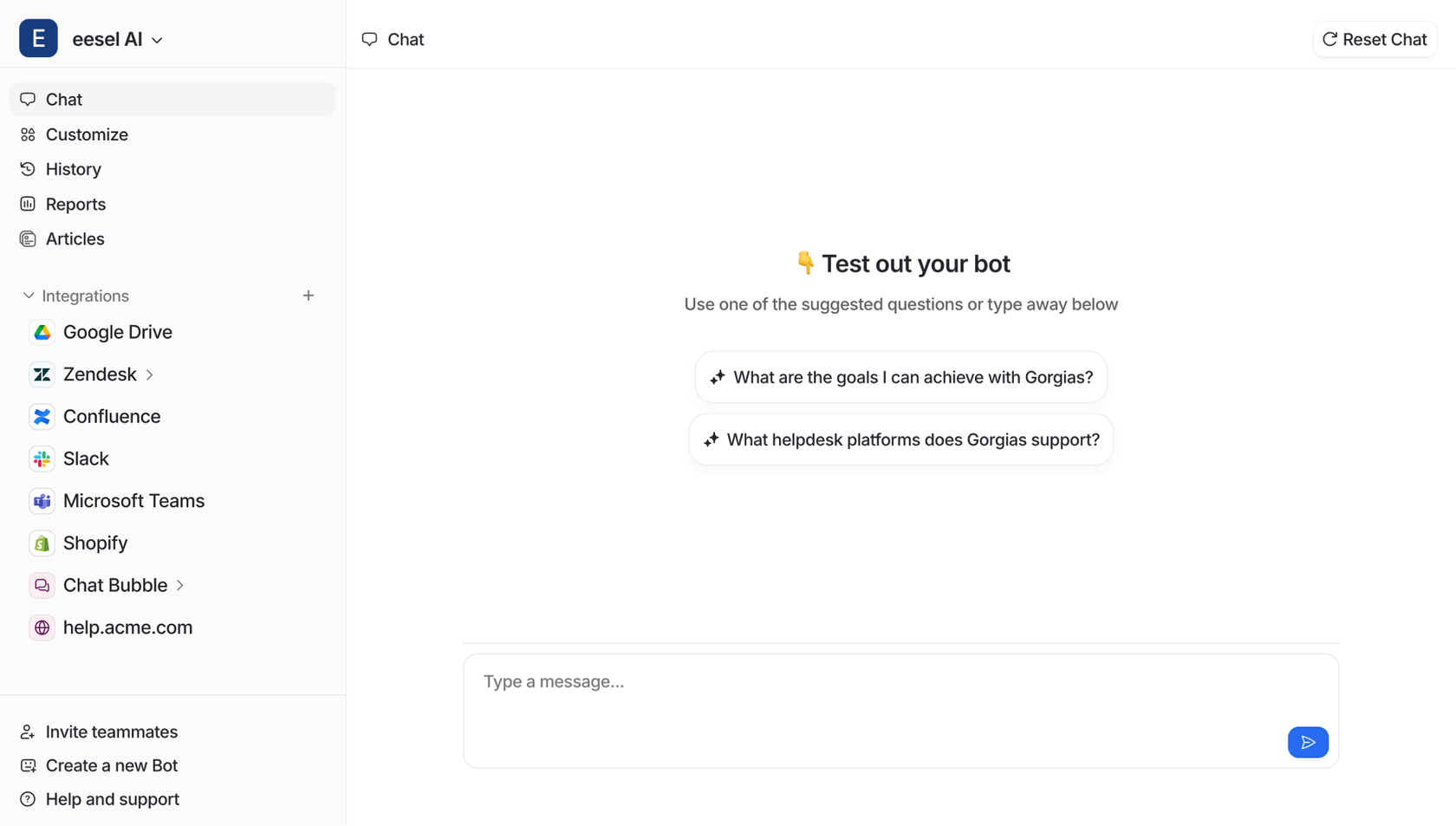
A modern alternative: eesel AI
Both Re:amaze and Freshdesk approach customer support as tools you configure. You set up workflows, create rules, and train your team to use the system effectively. This works, but it takes time.
We built eesel AI on a different premise: you don't configure an AI teammate, you hire one.
Instead of manually building workflows, eesel learns from your past tickets, help center articles, and connected documentation. Connect it to your help desk (whether that's Zendesk, Freshdesk, or others) and it immediately understands your business, tone, and common issues.
You start with guidance. eesel drafts replies for your agents to review. As it proves itself, you expand its scope until it's handling full conversations autonomously. The escalation rules are written in plain English: "Always escalate billing disputes to a human" or "For VIP customers, CC the account manager."
The teammate model means you see how eesel performs before it's customer-facing. Run simulations on thousands of past tickets to measure quality. Correct mistakes and eesel learns continuously. No retraining cycles, no re-uploads.
For teams comparing Re:amaze vs Freshdesk, eesel offers a third path: AI-native support that learns your business in minutes instead of weeks.
Making your decision
Here's the short version:
Choose Re:amaze if you're an ecommerce business that values deep platform integrations and straightforward pricing. The Shopify-native workflow and flat-rate Starter plan are genuinely differentiated advantages for online retailers.
Choose Freshdesk if you need enterprise-grade features, mature AI, and the flexibility to handle complex support scenarios across multiple channels. The broader ecosystem and proven scale make it the safer bet for larger organizations.
If you're curious about an AI-native approach that learns from your existing data rather than requiring manual configuration, try eesel AI alongside your evaluation. The teammate model represents a fundamentally different way to think about automated support.
The right choice depends on your specific workflows, team size, and growth trajectory. All three platforms offer free trials, so you can test how each fits your actual support volume before committing.
Frequently Asked Questions

Share this post
Article by
Stevia Putri
Stevia Putri is a marketing generalist at eesel AI, where she helps turn powerful AI tools into stories that resonate. She’s driven by curiosity, clarity, and the human side of technology.