

Education IT teams face a support problem that most corporate teams don't. Their users include students who've never filed a ticket, parents who only call during a crisis, faculty who prefer email, and administrators managing enrollment on legacy systems. Meanwhile, the IT department is often two or three people covering thousands of requests across multiple campuses, device programs, and departments - all while staying FERPA-compliant on a fixed annual budget.
The wrong helpdesk makes all of this worse. The right one handles the ticket volume, routes to the right team, integrates with Google Workspace or Microsoft 365, and doesn't eat the entire IT budget. Here are the seven platforms that actually work for educational institutions in 2026, with real pricing, real case studies, and an honest take on who each one is for.
What schools need from a helpdesk
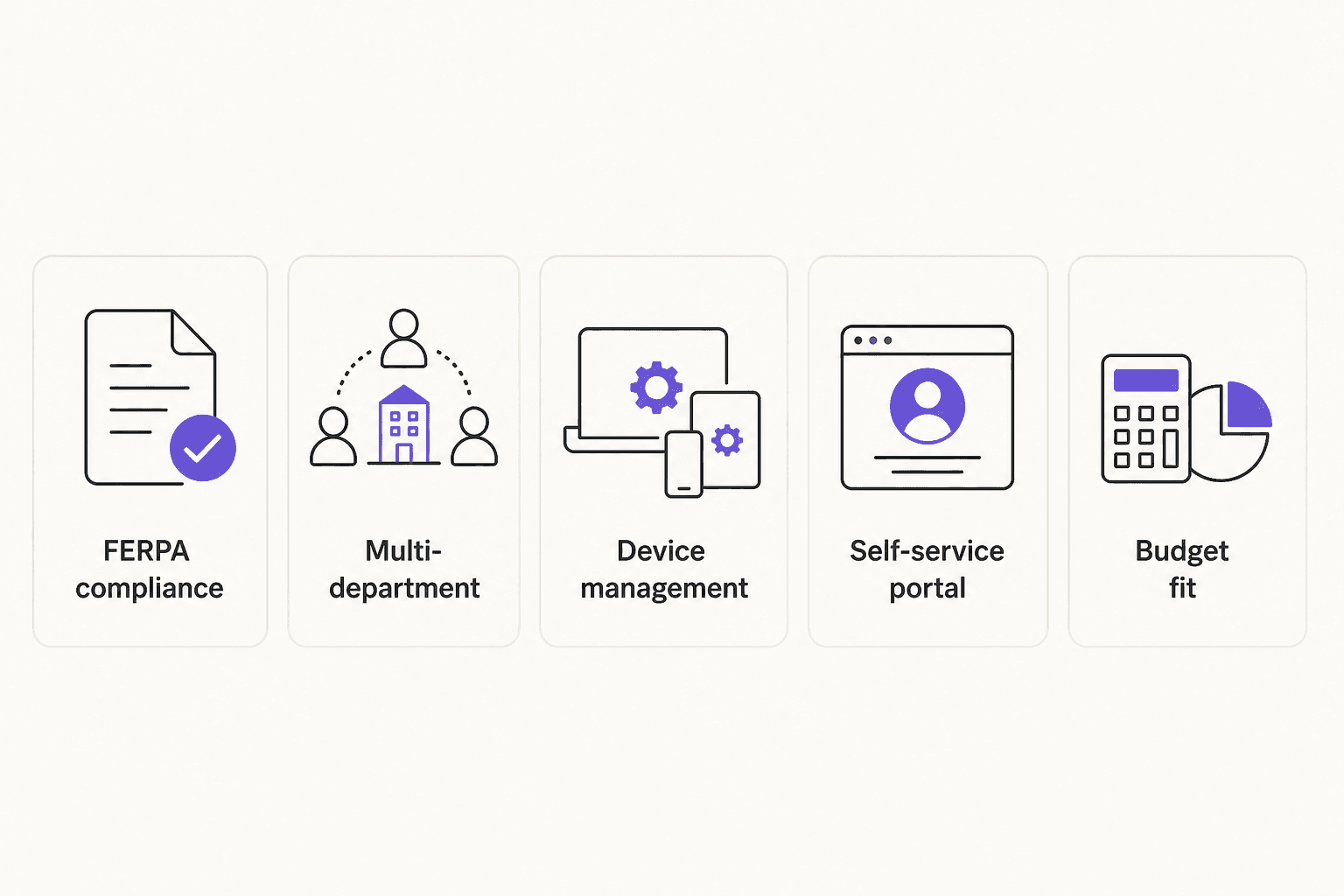
Education buyers care about five things that most corporate buyers don't prioritize in the same way.
FERPA compliance and data security. In the US, FERPA requires that student education records stay private. Any support ticket containing student data becomes a FERPA-protected record. That means role-based access controls, audit trails, and data encryption are legal requirements, not optional features. The Office Gurus' analysis of higher education compliance puts it plainly: "91% of higher education institutions experienced a cyber attack in the past 12 months." Granular permissions that control which agent sees which ticket aren't nice-to-have - they're table stakes.
Multi-department support. A campus is not just IT. Facilities handles room repairs. Financial aid handles tuition questions. The registrar handles enrollment. HR handles staff issues. Most institutions want a single platform routing all of this, with separate SLAs and permission sets per department so agents in financial aid can't accidentally access IT tickets about student account vulnerabilities.
Device and asset management. K-12 districts often manage thousands of Chromebooks under 1:1 programs. Universities track laptops, lab equipment, and software licenses across thousands of users. A helpdesk that can't link a ticket to a device record means an IT tech spending ten minutes searching for context every time a student reports a broken laptop.
Self-service portal. Schools run lean. A knowledge base where students and staff can find answers before filing a ticket is the difference between a manageable queue and one that's perpetually behind. Southern Oregon University relies heavily on its user-facing help center specifically to deflect tickets for common queries.
Budget fit. Public schools operate on fixed annual budgets with multi-year procurement cycles. Per-agent pricing that seems reasonable for a 20-person corporate support team becomes a problem when you have six IT staff covering 3,000 students. Free tiers, education discounts, and flat-rate pricing matter more here than anywhere else.
The 7 best helpdesk tools for schools and universities
Here is how the main platforms compare on the criteria that matter to education buyers:
| Tool | Best for | Starting price | Free tier? |
|---|---|---|---|
| Freshservice | University IT departments | $19/agent/mo | No (14-day trial) |
| HappyFox | Multi-department campus support | $21/agent/mo | No |
| Freshdesk | K-12 and smaller institutions | $19/agent/mo | Yes (6 months) |
| Jira Service Management | Atlassian-invested universities | Free-$20/agent/mo | Yes (3 agents) |
| Zoho Desk | Budget-conscious mid-size schools | $14/user/mo | Yes (3 users) |
| Spiceworks | Small K-12 IT teams | Free | Yes (permanent) |
| Zendesk | Large enterprise universities | $55/agent/mo | No (trial only) |
1. Freshservice
Freshservice is a full ITSM platform from Freshworks built specifically for complex service environments. The higher education version combines incident management, IT asset management (ITAM), enterprise service management (ESM), and Freddy AI on a single platform.
The education case studies are specific and current. University of Aberdeen ditched their legacy ITSM system, then saw an 81% reduction in ticket resolution time, a 208% increase in ticket-handling capacity, and a 98.6% CSAT score. D'Youville University in Buffalo moved from on-premise SolarWinds to Freshservice and hit 91% SLA compliance in their first year, while improving asset tracking accuracy from 45% to 95%. Texas A&M uses Freshservice to manage 50,000+ students, faculty, staff, and gameday visitors. University of Pennsylvania processed 30,000 support tickets across 30+ departments in their first six months on the platform.
On the AI side, Freshservice's Freddy AI handles ticket categorization, routing, and auto-resolution. The platform reports 66% ticket deflection with AI-powered self-service and a 77% decrease in average resolution time for AI-assisted workflows. The asset loan tracking module specifically covers the university use case of temporary device checkouts, with automated return reminder alerts and warranty expiry notifications.
Pricing: Starter $19/agent/month · Growth $49 · Pro $99 · Enterprise (contact sales). Annual billing; 14-day free trial, no credit card required.
Pros:
- Nine confirmed university customers including Aberdeen (81% resolution time reduction), Texas A&M, UPenn
- Full ITSM + ITAM + ESM in one platform
- Freddy AI handles routine requests end-to-end
- Service catalog extends to HR, facilities, and admissions
- 356% ROI in under 6 months per Forrester TEI study
Cons:
- Growth plan ($49/agent/month) is the practical entry for asset management - Starter doesn't include it
- No published education discount
- More complex than K-12 schools need
Best for: University IT departments managing multi-campus ecosystems, seasonal ticket surges, and cross-departmental service delivery.
2. HappyFox
HappyFox has the deepest education-specific positioning of any general-purpose helpdesk on this list. The platform is explicitly designed for the multi-department campus: IT, facilities, HR, student services, and finance all run on one platform with separate queues, SLAs, and workflows. Named education customers include Dartmouth University, Harvard, Academy District 20, Webster Central School District, and Pinewood Private School.
The Dartmouth case is well-documented: 6,744 students, 943 academic staff, and 3,266 administrative staff. After implementing HappyFox for facilities management, Director of IT Operations Justin Gere noted: "Transitioning to HappyFox was transformative, streamlining our workflow and expediting response times for facilities-related repairs." The platform covered asset management, automated work order routing, and a real-time portal for students and staff to track request status.
Smart Rules automatically route requests by campus, department, type, and priority. HappyFox integrates with ClassLink for SSO, Google Endpoint for Chromebook management, and Microsoft Intune for Windows device fleets. The 10% education discount applies to all annual subscriptions. For FERPA compliance, the platform supports granular role-based permissions and provides SOC 2 Type II, HIPAA, and GDPR compliance certifications.
Pricing: Basic $21/agent/month · Team $39 · Pro $89 · Enterprise PRO (contact sales). Annual billing only.
Pros:
- Dartmouth, Harvard, Academy District 20, Webster Central School District as confirmed customers
- ClassLink and Google Workspace SSO built-in
- Multi-department routing with per-department SLAs
- 10% education discount
- 401% ROI per Forrester TEI study
Cons:
- No free tier; demo-first model adds friction for budget-conscious procurement
- Pro plan ($89/agent/month) needed for task management, asset management, and 24/7 phone support
- Monthly billing not available
Best for: Schools and universities that need one platform for IT, facilities, HR, and student services - particularly those running on Google Workspace or ClassLink.
3. Freshdesk
Freshdesk is the accessible sibling to Freshservice. Where Freshservice is built around ITSM discipline, Freshdesk is built around omnichannel ticket management: consolidating requests from email, phone, live chat, social media, and web forms into a single workspace. It is used by 74,000+ businesses and is a common first helpdesk for K-12 schools moving off email-only support.
Freshworks has an education-focused landing page covering student and faculty support, recruitment workflows, and self-service. For K-12 IT teams, the 6-month free trial (no credit card required) is a meaningful advantage - you can test the platform with real ticket volume before committing to a license. Freshdesk's Freddy AI agent handles routine queries with up to 80% auto-resolution on supported workflows. Password resets, network access requests, and account setup questions - the most common K-12 IT tickets - are exactly what Freddy handles.
Freshdesk does not include ITSM features like change management, problem management, or a full CMDB. For schools that only need ticket routing and a knowledge base, that's fine. For university IT departments that need to track changes and manage assets formally, Freshservice is the right product.
Pricing: Free (1-2 agents, 6 months only) · Growth $19/agent/month · Pro $55 · Enterprise $89. Annual billing; 14-day trial available.
Pros:
- 6-month free tier lets schools test with real traffic before paying
- Growth plan at $19/agent/month is competitive
- Easy to set up - most schools can configure it in a day
- Freddy AI Copilot improves agent productivity by 60%
Cons:
- Free tier expires; not a permanent option
- No built-in ITSM (no change management, CMDB, or formal problem management)
- Asset management requires a third-party integration
- Less education-specific positioning than Freshservice or HappyFox
Best for: K-12 schools moving from email-based support to their first real ticketing system, and smaller colleges that don't need formal ITSM discipline.
4. Jira Service Management
Jira Service Management (JSM) is not marketed specifically for education, but it has significant real-world adoption in higher education IT. Portland State University, Syracuse University, and Minneapolis College all run live JSM instances. The pull is clear: if your engineering or IT team already uses Jira for project tracking, JSM connects service requests directly to that work. A student reports a broken lab printer; the ticket links to the procurement project tracking the replacement hardware.
Atlassian's academic licensing program offers 50-75% off list prices for qualifying collegiate institutions - bringing JSM Premium from ~$51/agent/month down to roughly $13-25/agent/month at the high end. The free tier (3 agents, unlimited customers) is genuinely usable for small college departments handling modest request volumes.
JSM's virtual service agent on Premium handles conversational AI support, answering questions from the Confluence knowledge base and triaging requests before they reach human agents. The Rovo AI layer provides cross-product search across Confluence, Jira, and connected tools - useful when a student issue requires pulling context from a course catalog in Confluence or a hardware inventory in Jira Assets. For a full review of Jira Service Management in 2026, including how it compares to alternatives, see our separate guide.
Pricing: Free (3 agents) · Standard ~$20/agent/month · Premium ~$51/agent/month. Enterprise: contact sales. 50-75% academic discounts available.
Pros:
- Free tier is genuinely useful for 3-agent small departments
- 50-75% academic licensing discounts for qualifying institutions
- Tight Confluence integration for knowledge management
- 275% three-year ROI per Forrester
- Full ITSM (change management, CMDB, AIOps) on Premium
Cons:
- Complex configuration - not friendly for non-technical admins
- AI virtual service agent requires Premium (before discounts)
- Less intuitive interface for general staff than Freshdesk or Zoho Desk
Best for: Universities and colleges already in the Atlassian ecosystem; IT teams looking to move off ServiceNow without losing ITSM depth. See our Jira AI agents guide for adding automation on top.
5. Zoho Desk
Zoho Desk is the most affordable full-featured helpdesk on this list. At $14/user/month for Standard (and $23 for Professional), it undercuts most competitors while still offering omnichannel ticketing, a knowledge base, workflow automation, and the Zia AI assistant.
Zoho maintains a dedicated education landing page covering admissions inquiries, exam portal access, scholarship questions, and student service workflows. AMA University Online Education (Philippines) migrated to Zoho Desk and hit 90% SLA compliance and a 20% increase in student happiness ratings.
The Professional plan includes multilingual support in 40+ languages, relevant for universities serving international students. Zoho Desk integrates with 360+ apps and the full Zoho ecosystem - useful if a school already uses Zoho CRM or Zoho People. Educational institutions can request discounts directly from Zoho, though specific discount rates are not published.
Pricing: Free (3 users) · Express $7/user/month · Standard $14 · Professional $23 · Enterprise $40. Annual billing; 15-day free trial, no credit card required.
Pros:
- Lowest per-user pricing of any full-featured option here
- Free plan for up to 3 users with email ticketing and basic workflows
- Multilingual support (40+ languages) in Professional tier
- AMA University Online Education: 90% SLA compliance
- 360+ integrations
Cons:
- Education discount rates not published; requires a sales conversation
- UI is less modern compared to Freshdesk or HappyFox
- Zia AI is less capable than Freddy AI or Zendesk's suite
- No built-in ITSM (no formal incident, problem, or change management)
Best for: Budget-constrained mid-size schools that need omnichannel support and can't absorb Freshservice or HappyFox per-agent pricing.
6. Spiceworks
Spiceworks Cloud Help Desk is permanently free for core ticketing. Not a time-limited trial, not a seat-limited plan - permanently free, ad-supported, with full ticketing, a knowledge base, email-to-ticket routing, a user portal, and inventory management. PC Magazine named it the Best Help Desk Software for small businesses on a budget in 2024.
School IT administrators have used Spiceworks for over a decade. From the Spiceworks community education thread: "we are a small rural K-12 public school and have been using Spiceworks for over a year. it has helped immensely to manage and track the technology in the district." A secondary school with 100 staff and 1,300 students reported 75-80% of jobs logged correctly after staff training. Multiple UK primary schools use it across feeder school networks.
The adoption pattern in schools is consistent: the tool works well once staff understand that tickets replace corridor conversations, but getting there requires management backing and a mandatory-ticketing policy. Schools that treated Spiceworks as optional struggled; those that made it the only way to get IT help saw the ticket submission rates jump.
Note: Spiceworks deprecated their on-premise Desktop version at the end of 2021. The cloud-based version is the current product.
Pricing: Free Core plan (ad-supported, 1-5 technicians) · Premium $5/seat/month (removes ads, unlimited technicians, bulk actions, Power BI connector).
Pros:
- Permanently free with full ticketing, knowledge base, and inventory
- Mobile apps included on free plan (iOS/Android)
- 4M+ IT community for education-specific help and templates
- PC Magazine Best Help Desk Software 2024
Cons:
- Ads in the interface on the free tier
- Max 5 technicians on free plan
- No AI features on the core plan
- Setup requires DNS and firewall configuration
- Staff adoption requires a change management effort
Best for: Small K-12 IT teams that need professional ticketing and inventory tracking at zero cost and have the time to invest in setup and adoption.
7. Zendesk
Zendesk is the default choice at large research universities and enterprise-scale institutions where ticket volume, analytics depth, and integration breadth justify the cost. The platform powers 22,000+ service teams and has processed 4.8 billion resolutions. Zendesk's AI suite includes pre-trained intent models specifically for education - covering student inquiries, enrollment, financial aid questions, and IT support without requiring the institution to build custom training data.
The platform supports 80+ languages, relevant for university international programs and multilingual student populations. Suite Professional ($115/agent/month) includes HIPAA compliance, skills-based routing, and custom reporting - covering the data governance requirements many research institutions carry. The 1,800+ marketplace apps include integrations with student information systems, LMS platforms, and identity providers.
The community consensus is consistent with the product's profile: Zendesk is powerful, expensive, and needs a dedicated admin to get the most out of it. A university IT team with a Zendesk admin on staff gets an enormously capable platform. A K-12 IT team of two does not. If the cost is the friction, our best Zendesk AI alternatives guide covers what to consider.
Pricing: Support Team $19/agent/month · Suite Team $55 · Suite Professional $115 · Suite Enterprise $169. Annual billing; 14-day trial available.
Pros:
- 22,000+ teams, extremely mature and proven
- Pre-trained AI intent model for education
- 80+ language support
- 2025 Gartner Magic Quadrant Leader for CRM Customer Engagement Center
- 301% three-year ROI per Forrester
Cons:
- Suite Professional at $115/agent/month is expensive for education budgets
- Complex configuration - realizing the platform's value requires admin resources
- No published education discount
- Significant per-Reddit community frustration with pricing escalation
Best for: Large research universities with dedicated support operations staff, high ticket volumes, and budgets that can justify enterprise-grade tooling.
How to choose based on your institution
The right choice comes down to institution type, team size, and whether you need ITSM or general support.
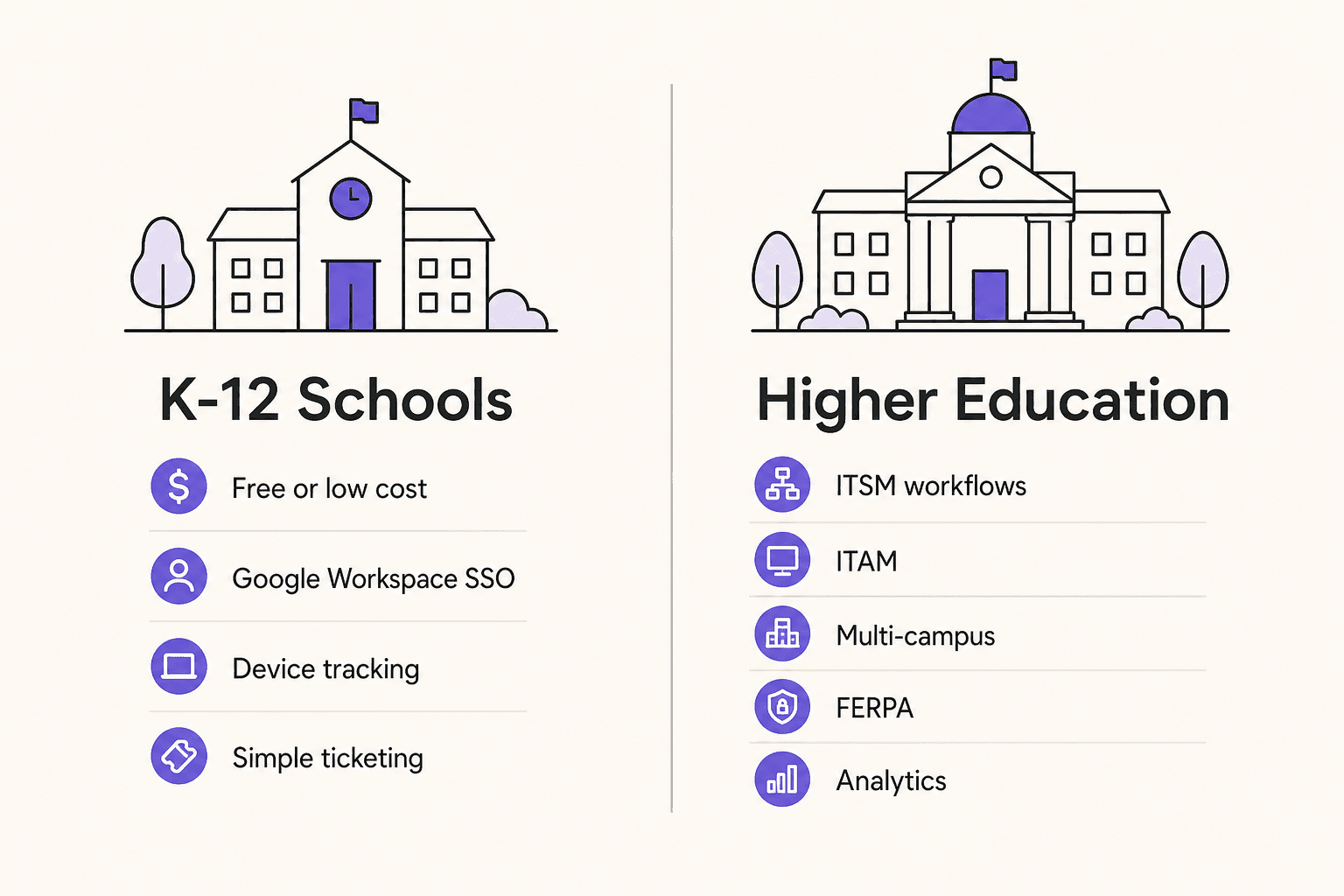
K-12 school districts with small IT teams and tight budgets should start with Spiceworks (permanently free) or Freshdesk (free for 6 months, then $19/agent/month). If you manage a 1:1 Chromebook program and need device tracking alongside ticketing, HappyFox's Google Endpoint integration is worth the per-agent cost.
Small colleges and community colleges with 3-10 IT staff should evaluate Jira Service Management (free tier for 3 agents, then 50-75% academic discounts) or Zoho Desk (free for 3 users, $14/user/month for Standard). If you need IT, facilities, and HR in one platform, HappyFox handles that cleanest.
Mid-size universities with a dedicated IT department need the ITSM features Freshservice or JSM Premium offer: change management, asset management, formal incident management. Freshservice has the stronger education case study record; JSM is the better fit if the institution is already invested in Atlassian tools like Confluence and Jira. See our ITSM vs helpdesk explainer if that distinction matters for your procurement conversation.
Large research universities with complex compliance requirements and high ticket volumes can justify Freshservice Enterprise or Zendesk Suite Professional. Both have the analytics, automation, and integration depth for the scale. Read our internal helpdesk best practices guide for how top IT teams structure operations at that scale.
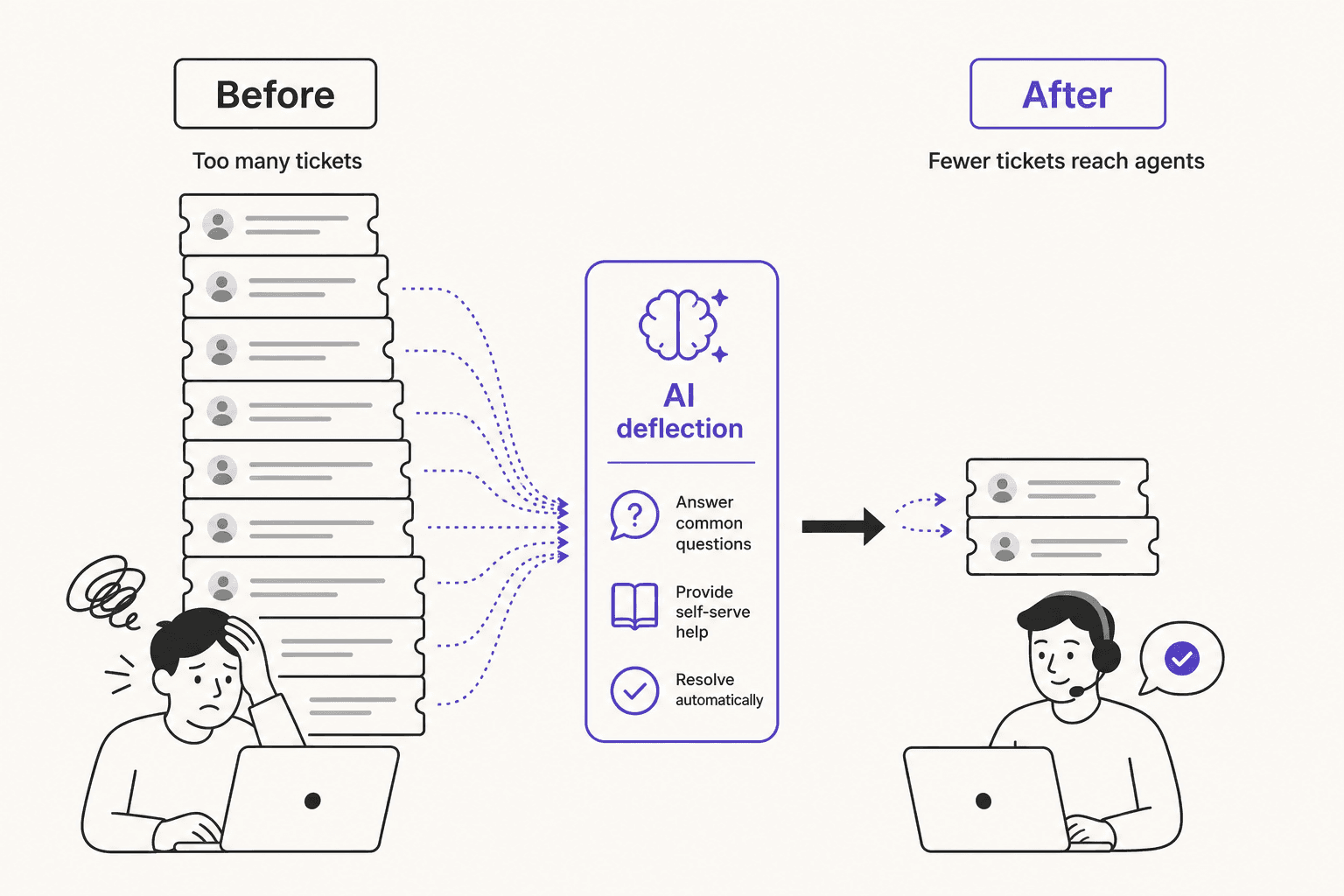
One decision worth making regardless of which platform you choose: whether to add an AI layer on top.
Try eesel AI
eesel AI is an AI helpdesk agent that works alongside any platform on this list - Zendesk, Freshdesk, Freshservice, Jira Service Management, HappyFox, and more. It learns from your resolved tickets and knowledge base articles, then drafts or sends replies autonomously. Setup takes minutes.
For education institutions, the math is simple. A school processing 500 tickets per month pays $200/month at eesel's $0.40/ticket pricing. No platform fee, no per-seat charge, and a $50 free trial that doesn't require a credit card. The AI handles the repetitive requests - password resets, network access, course portal logins, enrollment status questions - while escalating anything that needs human judgment. Customers report up to 80% time savings on AI-handled queries.
Freshdesk users can follow the complete guide to adding a no-code AI agent in Freshdesk. Zendesk users can get started through the eesel Zendesk integration. Teams on Jira can use the Jira chatbot guide. And if you want to see how to add AI to any helpdesk from scratch, that walkthrough covers the setup end to end.

Frequently Asked Questions
Share this article

Article by
Stevia Putri
Stevia Putri is a marketing generalist at eesel AI, where she helps turn powerful AI tools into stories that resonate. She’s driven by curiosity, clarity, and the human side of technology.