We've all been there. One minute you're happily saving files to Google Drive, your digital-filing-cabinet-in-the-cloud. The next, a bright red "Storage full" notification ruins your day. Now you're staring at upgrade options like Google One and Google Workspace, trying to figure out what they even are, let alone which one you need.
The main reason for the confusion is that Google splits its storage into two different buckets: one for personal use (Google One) and one for business use (Google Workspace). They both give you more room in Google Drive, but they're designed for completely different worlds.
This guide cuts through the noise. I'll break down the Google Drive pricing structure as it stands in 2026, show how the plans stack up, and help you figure out which one makes the most sense for you or your business.
Understanding Google Drive: Drive vs. One vs. Workspace
Before we get into the dollars and cents, let's get the names straight. People often use them interchangeably, but they're not the same thing.
Think of it like this:
- Google Drive: This is the cloud storage service itself. It's the digital space where your files, photos, and documents live. It's the foundation.
- Google One: This is the paid plan for your personal Google account. When you need more than the free 15 GB, you're buying a Google One subscription. It boosts your storage across Drive, Gmail, and Photos and throws in a few extra consumer perks.
- Google Workspace: This is the whole toolkit for businesses. It bundles Drive with professional must-haves like a custom email domain (@yourcompany.com), beefed-up security, admin controls, and features built for teamwork. I cover the business side in depth in my Google Workspace pricing breakdown.
Here's a quick way to keep them separate:
| Term | What It Is | Who It's For |
|---|---|---|
| Google Drive | The cloud storage service for your files. | Everyone |
| Google One | A paid subscription for more storage and personal perks. | Individuals & Families |
| Google Workspace | A paid suite of business apps, including Drive with team features. | Businesses & Organizations |
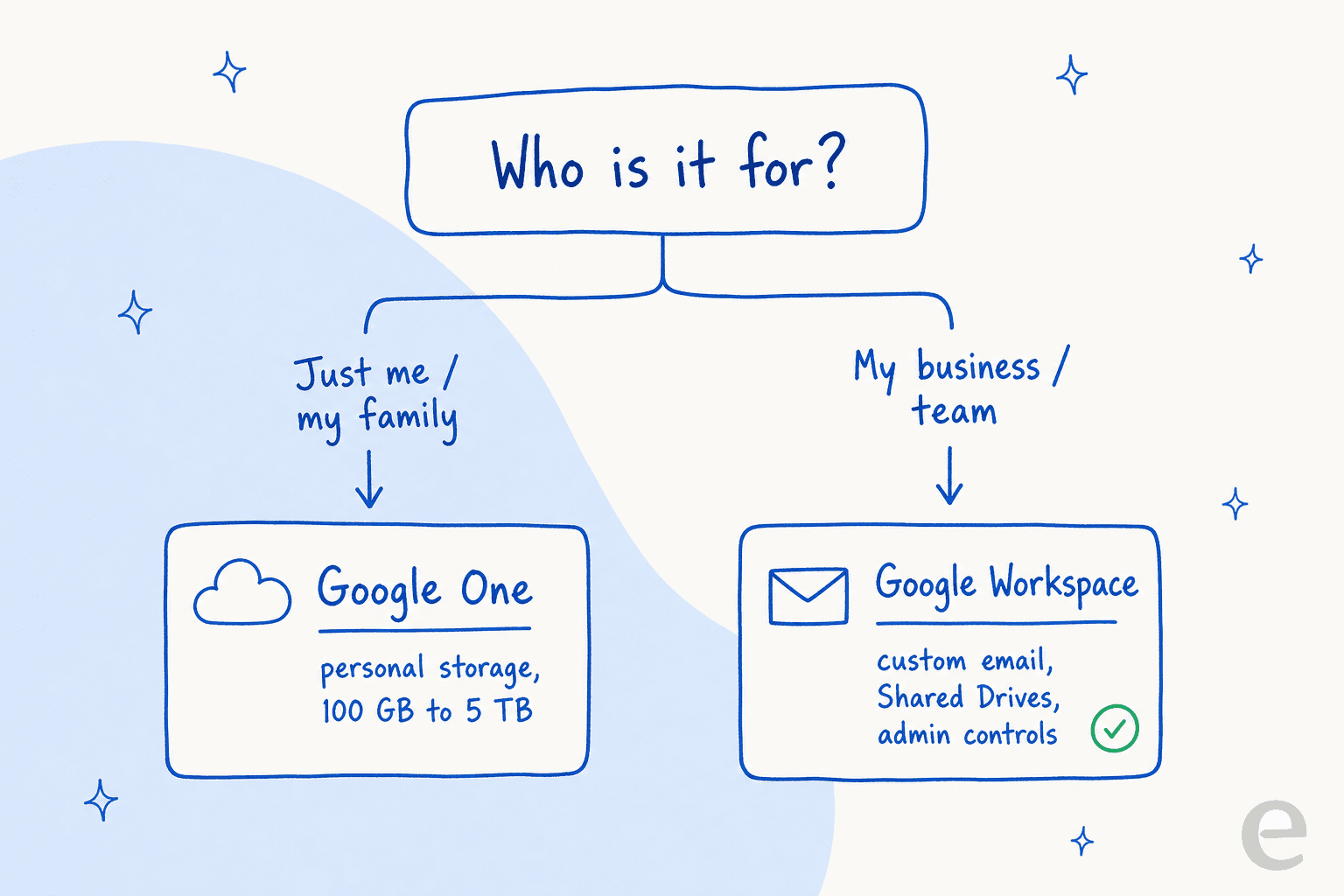
Not sure which side of that table you're on? Here's the same decision in one picture.
Google Drive pricing for you and your family: Google One plans
If you're just a regular person trying to back up your phone, or an individual who needs to share storage with family, Google One is what you're looking for. Every Google account gets 15 GB for free, but let's be honest, that disappears fast with a few years of photos and email attachments. When it's time to upgrade, you'll pick from one of the Google One plans.
Google One tiers and what you get
The Google One plans are pretty simple. You pay more, you get more storage, and the pricier plans add a few extra benefits. The big shift in 2026 is that Google merged its AI tools straight into the storage tiers, so the old "Premium" plan is now Google AI Plus and the top tier, Google AI Pro, jumped from 2 TB to 5 TB.
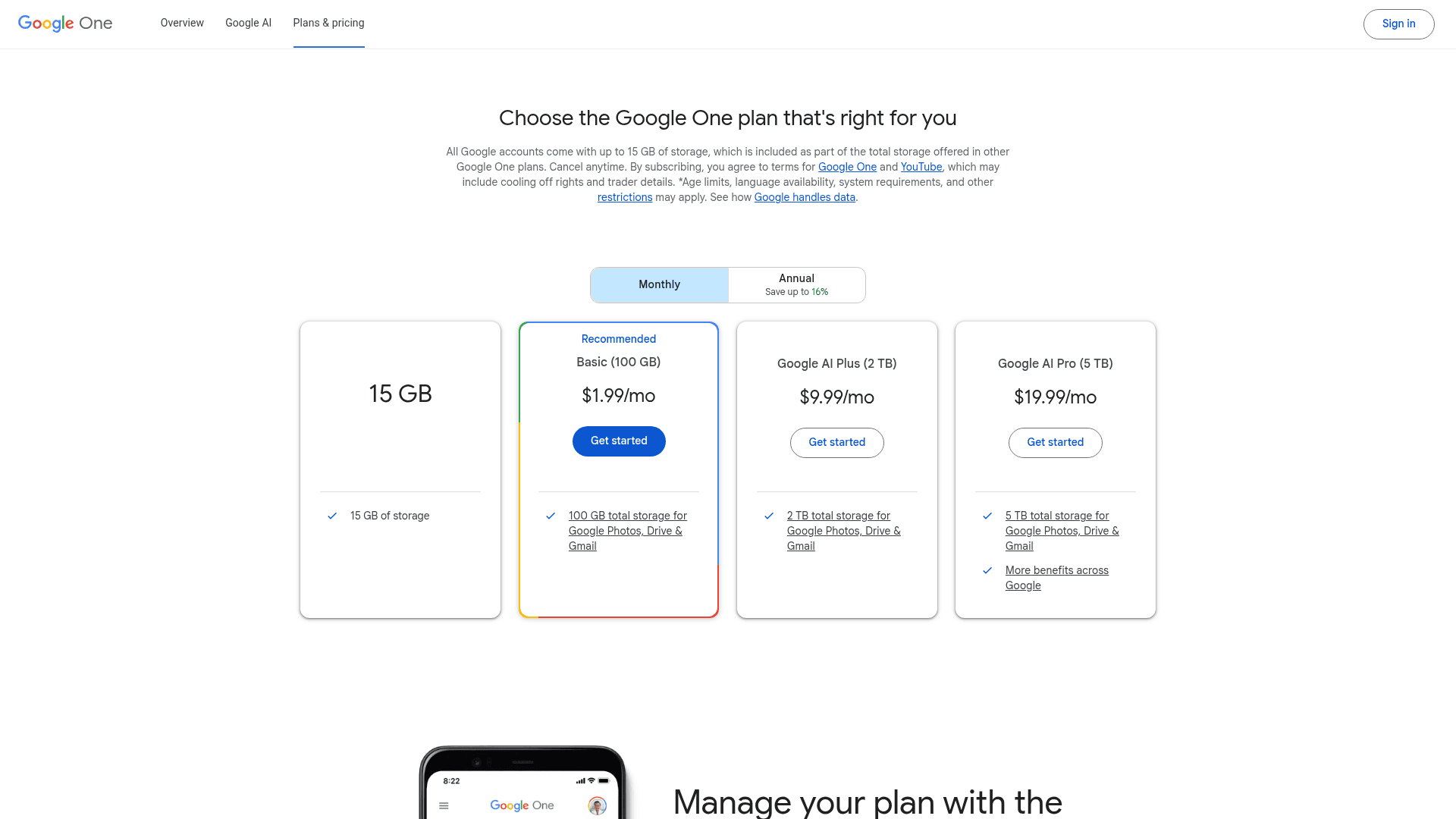
| Plan | Price (Monthly) | Price (Annual) | Storage | What You Really Get |
|---|---|---|---|---|
| Free | $0 | $0 | 15 GB | Shared across Drive, Gmail, & Photos. |
| Basic | $1.99/mo | $19.99/yr | 100 GB | Share with up to 5 others, access to Google support. |
| Google AI Plus | $9.99/mo | ~$99.99/yr | 2 TB | Everything in Basic + the Gemini app, 10% back on Google Store purchases, premium Workspace features. |
| Google AI Pro | $19.99/mo | ~$199.99/yr | 5 TB | Everything in AI Plus + Google's most capable Gemini 3 models, Gemini in Docs and Gmail, more perks. |
_Note: Prices are based on the US region and can change; annual billing saves up to ~16%. Source: Plans & Pricing to Upgrade Your Cloud Storage – Google One_
Who are these Google One plans actually for?
- Free (15 GB): This is for the minimalist. If you mostly write in Google Docs (which take up almost no space) and are disciplined about cleaning out your Gmail, you might be able to survive on this. For a while, anyway.
- Basic (100 GB): This is the sweet spot for most individuals. It gives you enough breathing room to automatically back up your phone's photos and videos without worrying, and to store a decent amount of files.
- Google AI Plus (2 TB): This is the plan for families, content creators, or the designated family photo archivist. If you're storing big files like high-res photos and 4K video, or have multiple people backing up devices, 2 TB has plenty of space, and you now get the Gemini app bundled in too.
- Google AI Pro (5 TB): This one's for tech enthusiasts and professionals who want to go all-in on Google's AI. On top of the bigger 5 TB pool, it unlocks Google's most capable Gemini 3 models and Gemini in Google Docs to help draft emails, organize ideas, and generate images.
Google Drive pricing for your business: Google Workspace plans
For businesses, Google Drive pricing is wrapped inside a Google Workspace subscription. This is a big deal, because you're not just buying storage space, you're getting a whole suite of tools built for security, administration, and teamwork. It's what transforms Google Drive from a personal shoebox of files into a secure hub for your entire company.
Google Workspace tiers
The business plans scale up based on storage, security needs, and how many people you can have in a Google Meet call. One of the biggest unlocks with the paid plans is Shared Drives, which is a must-have for any team. As of 2026, every Workspace plan also bundles the Gemini AI assistant across Gmail, Docs, and Meet, so AI is baked into the per-user price rather than sold separately.
| Plan | Price (per user/mo) | Pooled Storage | What You Really Get |
|---|---|---|---|
| Business Starter | $7 | 30 GB per user | Custom email, Gemini in Gmail, 100-person video meetings, standard security. |
| Business Standard | $14 | 2 TB per user | Everything in Starter + 150-person meetings with recording, Shared Drives. |
| Business Plus | $22 | 5 TB per user | Everything in Standard + 500-person meetings, eDiscovery, better security. |
| Enterprise | Contact Sales | 5 TB+ per user | Everything in Plus + top-tier encryption, advanced controls, premium support. |
*Note: Prices assume an annual commitment in the US region; new customers often see an intro discount for the first few months. Source: Compare Flexible Pricing Plan Options | Google Workspace
Understanding pooled storage and shared drives
Two concepts are key to seeing the value in Google Workspace.
First is pooled storage. Unlike a personal plan where your storage is just for you, business storage is combined across all users. If your team of 10 is on the Business Standard plan, you don't have 10 separate 2 TB drives. Instead, your company gets one giant 20 TB pool of storage (10 users x 2 TB). This is flexible because some people on your team will use a ton of storage, while others will barely use any.
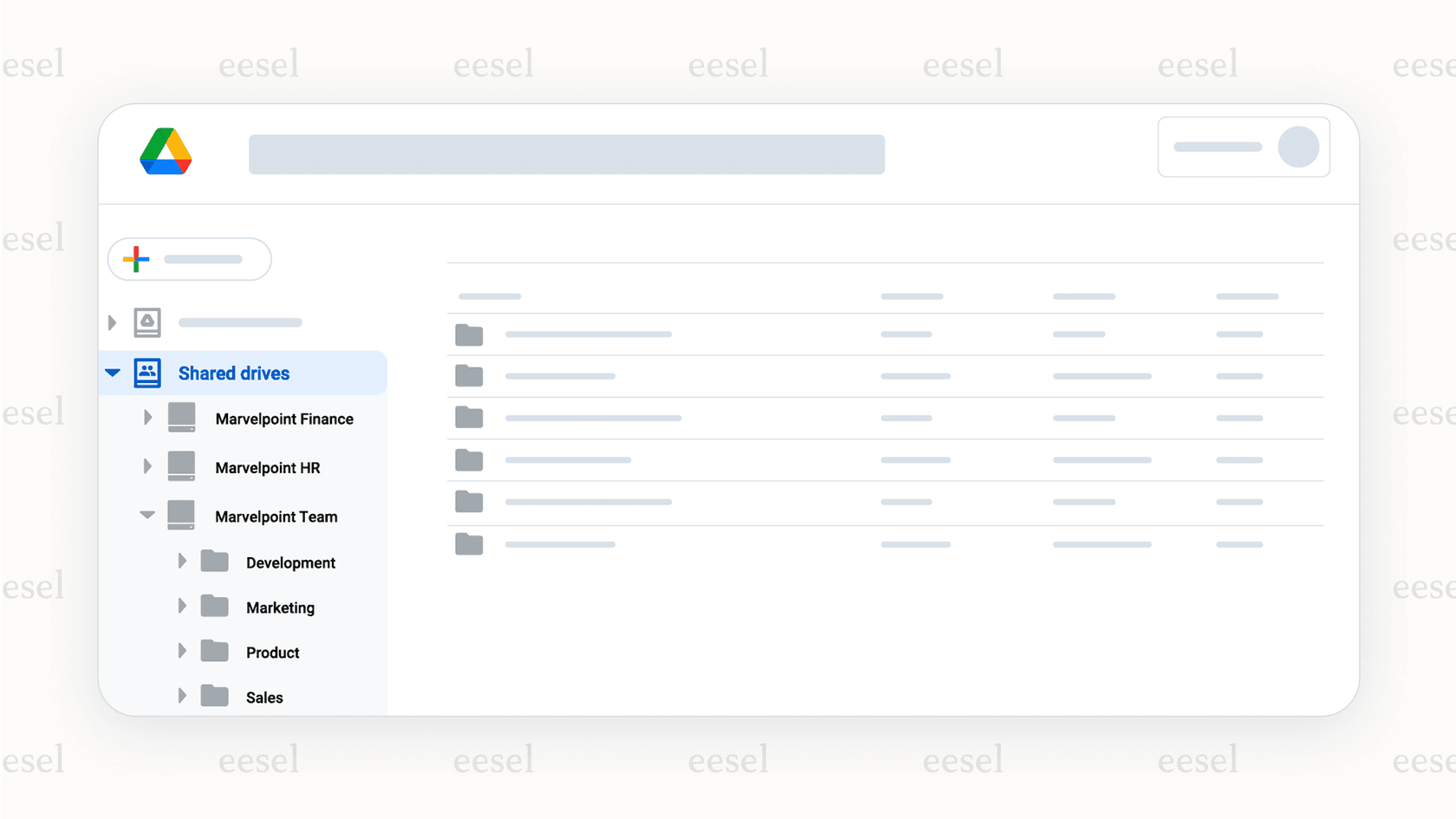
Now pay attention to this next part, because it's a huge deal for businesses: Shared Drives. In a regular Google Drive, every file is "owned" by the person who uploaded it. If that employee leaves, their files can become a nightmare to track down and transfer. With Shared Drives, the team owns the files. This is a lifesaver for making sure important documents don't walk out the door when an employee does, and it pairs naturally with a proper internal knowledge base.
If you're still weighing Google against the competition, my Google Drive alternatives and OneDrive breakdown cover the cost trade-offs side by side.
Beyond Google Drive pricing: When Google Drive isn't enough for your support team
Here's the catch: for all its strengths, Google Drive is basically a digital library. The information just sits on the shelf. For a busy customer support team that needs answers now, this creates some real headaches. Using Google Drive and Docs to store your internal knowledge is smart, but it quickly hits a wall when your team needs to use that information in real time.
The info is a pain to find
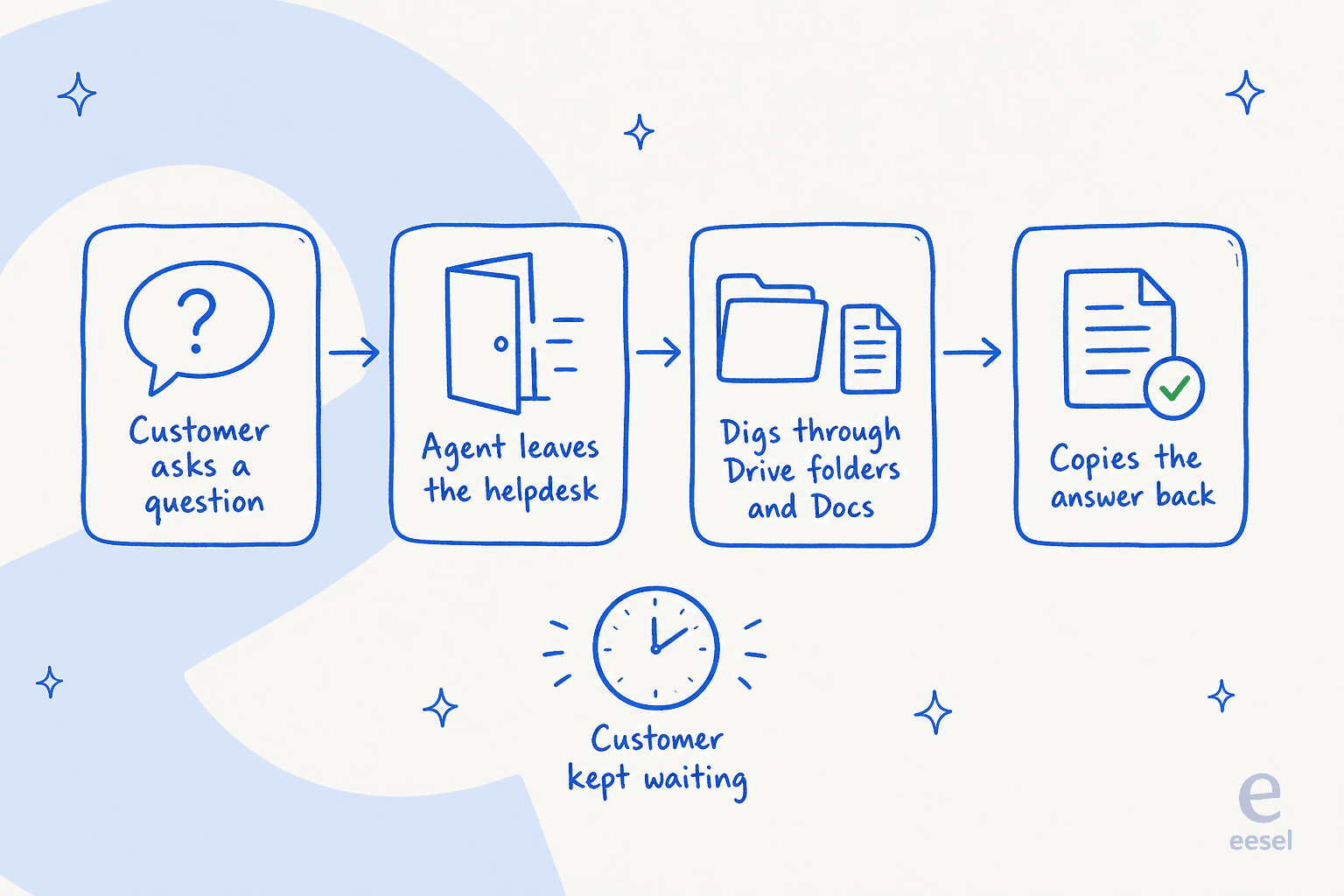
When a customer asks a question, an agent has to stop what they're doing, jump over to Drive, and start digging through folders, hoping to find the right answer. Every second they spend searching is a second a customer is left waiting, which is bad news for your response times and customer satisfaction.
Your knowledge is stranded on an island
Your support team lives in tools like Zendesk, Freshdesk, or Intercom. They talk to each other in Slack or MS Teams. But the answers they need are stranded over in Google Drive. That constant context-switching is exhausting and a massive drain on productivity, which is why I usually point teams toward a dedicated internal support chatbot.
It's a creation tool, not an automation tool
Google's own AI, Gemini, is great at helping you write a new policy in a Google Doc. But it can't take that policy and use it to automatically answer a customer ticket or resolve an employee's question in Slack. It helps you create the knowledge, but it doesn't help you put it to work. That's the difference between a writing assistant and a real AI knowledge base chatbot.
Making your Google Drive knowledge base actually work for you
The answer isn't to ditch Google Drive. All that knowledge you've carefully documented is gold. You just need a way to connect that static knowledge to the places where your team actually works.
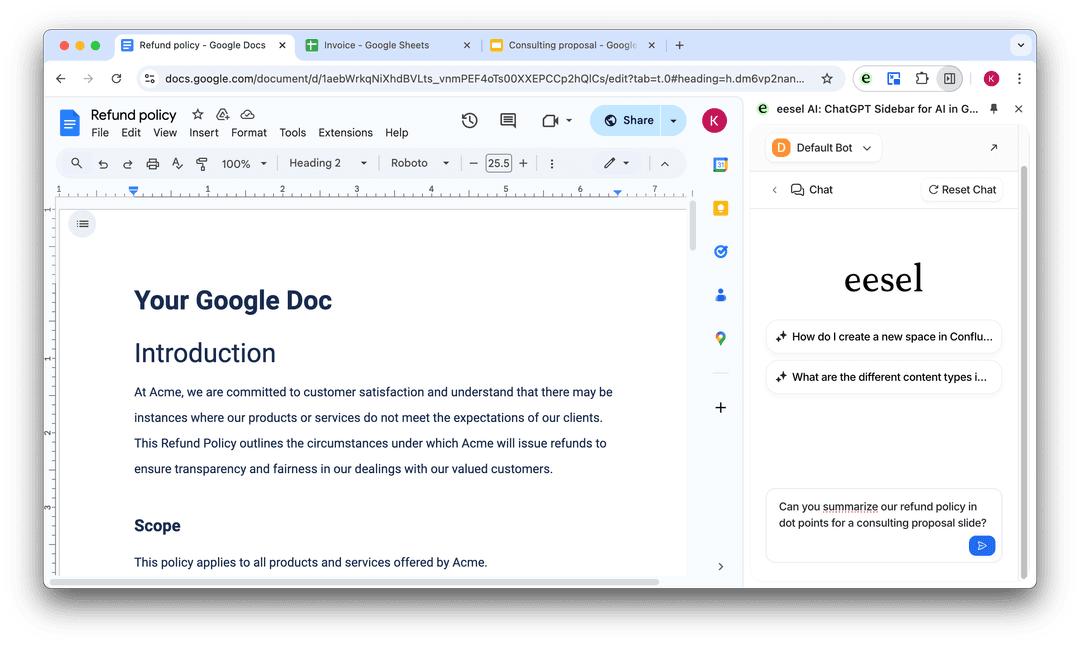
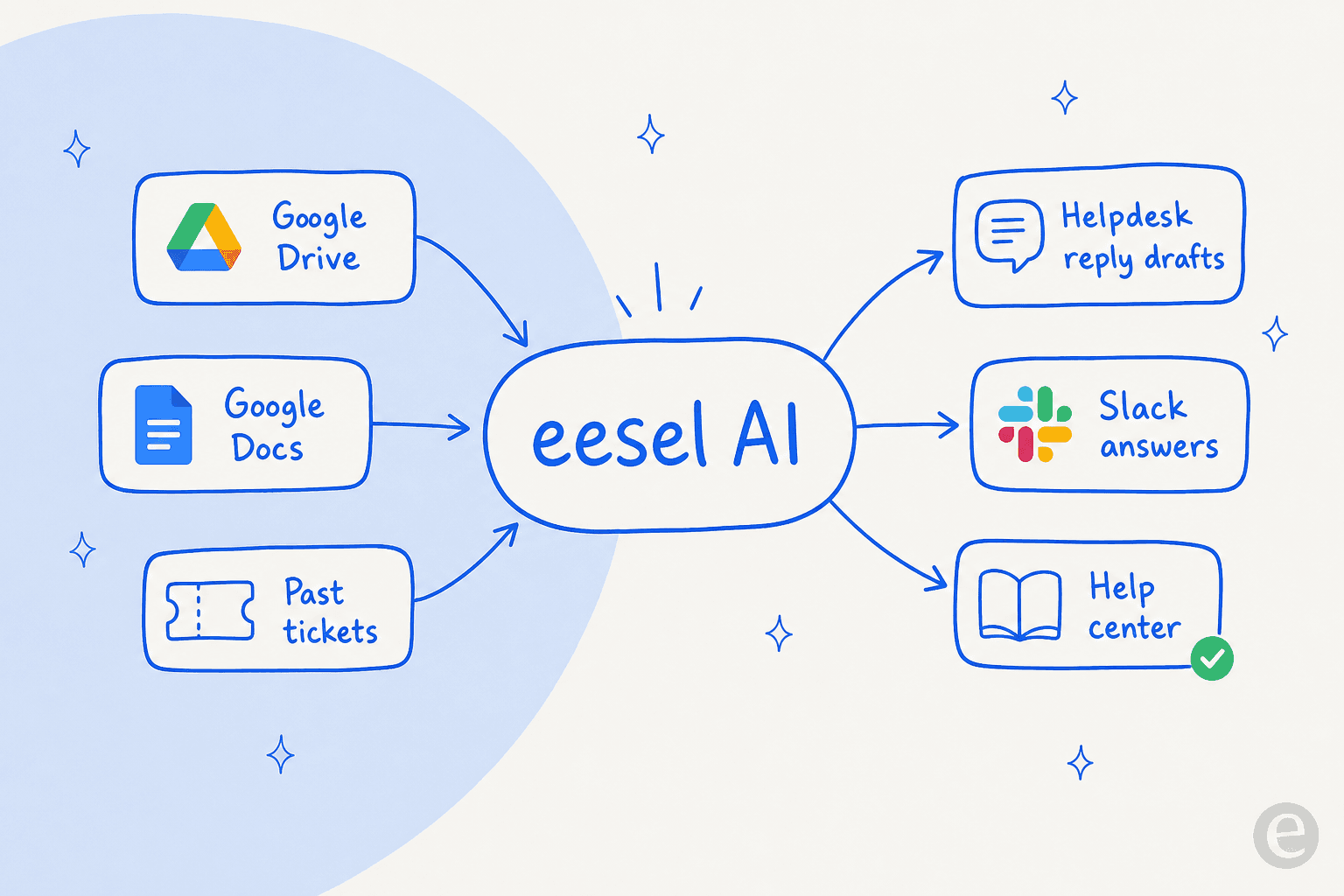
That's where a tool like eesel AI steps in. It acts like a smart bridge, connecting the information in your Google Docs, help center, and past support tickets directly to your team's workflow. Instead of agents digging for answers, an AI Copilot instantly drafts accurate replies right inside their help desk. An AI Internal Chat bot can answer team questions in Slack by referencing the content in your Drive, effectively turning your documentation into a 24/7 expert that's always on call. It's the same idea behind the best AI knowledge base tools, pointed at the docs you already keep in Drive.
Before any of this goes live, eesel runs a simulation against your historical tickets, so you can see how it would have answered real questions instead of crossing your fingers on day one. After years of watching confident-sounding bots quietly give wrong answers, that dry run is the part I'd never skip.
The eesel AI Copilot, an effective way to surface the right answer from your Google Drive without leaving the helpdesk.
Picking the right Google Drive pricing plan
Figuring out Google Drive pricing doesn't have to be a headache. It really just boils down to one question: are you using it for personal stuff or for your business?
For you and your family, Google One gives you simple storage upgrades with a few nice extras, and a fuller picture lives in my Google Drive review. For your business, Google Workspace is the way to go, giving you a secure, collaborative platform where Drive is just one piece of the puzzle.
Choosing the right plan is the first step. But the real win is making sure the information you store there is easy for your team to find and use.
Put your Google Drive knowledge to work with eesel
Don't let your valuable SOPs and guides gather digital dust. eesel AI can activate the information locked inside your Google Docs, turning it into automated support, instant agent assistance, and an internal expert for your team. You'll cut down on repetitive work, see your response times drop, and train the AI on your knowledge in minutes, not weeks.
Ready to unlock the knowledge hidden in your Google Drive? Try eesel free or book a demo to see how it works.
Frequently asked questions
How do I know if the personal Google Drive pricing through Google One is enough, or if I should look at the business plans?
The personal Google Drive pricing is for individuals and families who just need more storage. If you need a professional email (@yourcompany.com), team features like Shared Drives, and admin controls, you should choose a Google Workspace plan instead.
When I'm looking at the Google Drive pricing, does that cost cover just my files, or does it include my Gmail and photos too?
The storage you get with any Google Drive pricing plan is shared across Google Drive, Gmail, and Google Photos. Upgrading gives you one larger pool for all three services, so you don't manage them separately. For a wider look at whether the storage is worth it, see my Google Drive review.
For the business plans, is the Google Drive pricing a flat fee for the whole company, or do I pay for each person?
The Google Drive pricing for Google Workspace is calculated on a per-user, per-month basis. Your total monthly cost is the price of your chosen plan multiplied by the number of users on your team. If you want the heavier Gemini tier, I break that down in my guide to Google AI Ultra.
Is there a discount in the Google Drive pricing if I pay for a whole year at once instead of monthly?
Yes. Most Google One and Google Workspace plans give you a discount of up to about 16% if you commit to an annual subscription instead of paying month-to-month. If you're still weighing it up, my Google Drive alternatives roundup compares the cost against other tools.
If I stick with the free option, is the Google Drive pricing really zero dollars forever?
Yes, the initial 15 GB of storage is permanently free for every Google account. You only need to consider paid Google Drive pricing plans when your storage needs grow beyond that 15 GB limit. For ideas on using the free tier well, see Google Drive AI.